
That West Texas rain can cause serious issues.
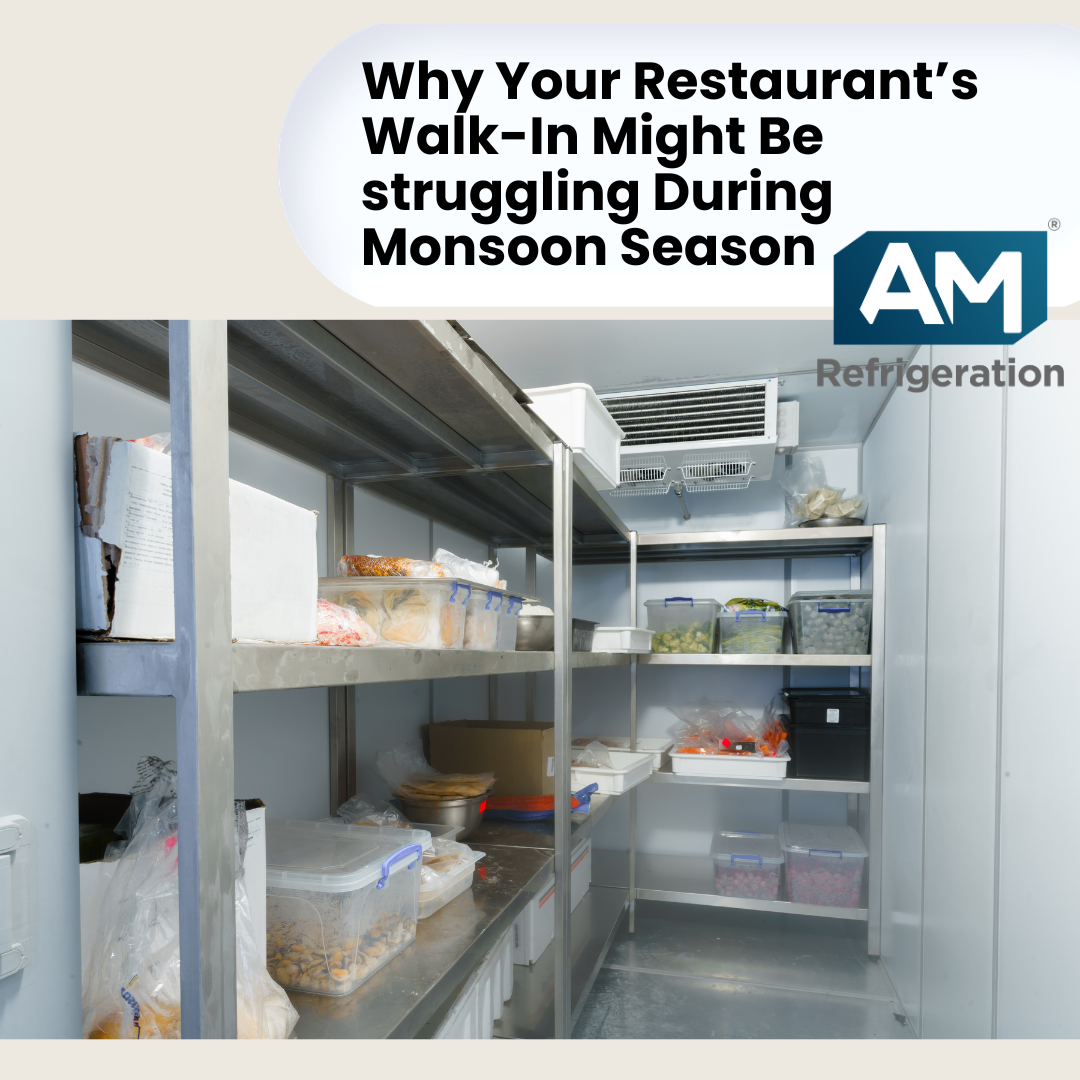
Monsoon season shows up in West Texas and eastern New Mexico like an uninvited guest...humid, unpredictable, and never on the schedule you'd pick. One afternoon it's 105°F and bone dry, the next it's a wall of clouds, blowing dust, and a downpour that floods the parking lot in twenty minutes. Your dining room adjusts. Your guests barely notice. But in the back of the house, your walk-in cooler is fighting a different battle and if nobody's watching it, that fight can end in spoiled inventory and a very expensive after-hours service call.
Here's what's actually happening to your equipment when the monsoons roll in, and what to do about it before it costs you a walk-in full of product.
The Hidden Enemy: Humidity
Most restaurant owners think of their walk-in's job as fighting heat. Really, it's fighting heat and moisture...and moisture is the sneakier opponent.
For most of the year, El Paso and the Permian Basin run dry, often in the 10–20% humidity range. Your evaporator coil is built around that reality. Then monsoon season hits and relative humidity can spike past 50–60% for days at a stretch. Every time the walk-in door opens, that heavier, wetter outside air rushes in, and your system has to pull moisture out of it as well as heat - a process refrigeration people call “latent load.” It's more work for the same compressor, running for longer cycles, more often.
The visible result is usually ice. Evaporator coils that stayed clean and frost-free all June suddenly start icing over in August. Ice on the coil blocks airflow, which makes the system struggle even harder to hold temperature, which pulls in more humid air to compensate for the poor circulation. It's a downward spiral, and it usually starts with something a kitchen manager writes off as “the cooler's just a little warmer than usual today.”
Storms, Power Blips, and Compressor Stress
Monsoon storms in this part of the country don't mess around. Microbursts, dust walls, and lightning-heavy cells can knock out power for a few seconds or a few hours - and either one is hard on a compressor.
A brief outage followed by power snapping back on can send a compressor into a restart before internal pressures have equalized, which is exactly the kind of stress that burns out a compressor early. If your restaurant doesn't have a hard-start kit or surge protection on refrigeration equipment, every storm season is effectively a game of chance with your most expensive component.
Longer outages create a second problem: once power's back, an already-warm walk-in has to work overtime to recover — right as the storm that caused the outage is still driving humidity through the roof. That's the worst possible combination for a system that's already running hot.
Dust Before the Rain, Mud After It
Monsoon season in West Texas rarely starts with rain. It starts with wind - the kind that kicks up a dust wall you can watch roll toward you from the roof. That dust doesn't stay outside. It settles into condenser coils, especially on rooftop units and pad-mounted condensers near loading docks, parking lots, and anywhere gravel or dirt is exposed.
A dirty condenser coil can't reject heat efficiently, so the system runs longer and hotter to do the same job - right before a storm dumps rain that turns all that settled dust into a caked, mud-like film. By the time the humidity spike from the storm arrives, the condenser is already working at a disadvantage. It's a one-two punch: dust reduces efficiency, then the storm locks that dust in place.
Warning Signs Your Walk-In Is Struggling
None of this happens overnight, and your walk-in will usually try to tell you before it fails outright. Here's what to watch for during monsoon season specifically:
● Condensation or frost where you haven't seen it before — around the door gasket, on interior walls, or dripping from the ceiling. This is a strong sign the system can't keep up with the added humidity load.
● Ice buildup on the evaporator coil or fan blades, especially if it wasn't there a month ago.
● Longer, more frequent compressor run cycles, or a compressor that never seems to fully cycle off.
● A noticeable rise in ambient temperature inside the box, even a few degrees, especially in the afternoon when outdoor humidity peaks.
● Unusual noise — grinding, squealing, or a labored hum — coming from the condensing unit, particularly right after a dust storm or heavy rain.
● Product sweating on shelving or packaging, which is a sign of humidity infiltration even if the temperature reading still looks fine.
Any one of these on its own might be nothing. Two or three together, during storm season, means the system is losing the fight.
What It Costs You If You Wait
It's tempting to let a “slightly warm” walk-in ride until the next scheduled maintenance visit. During monsoon season, that gamble gets more expensive fast.
A walk-in that drifts above 41°F for an extended stretch doesn't just risk spoiled product - it risks a health department violation if an inspector happens to check temperature logs on the wrong day. Proteins, dairy, and prepped items are the first casualties, and they're also usually the priciest items on your inventory sheet. A single bad afternoon can mean throwing out hundreds or thousands of dollars of product, on top of whatever it costs to fix the equipment that let it happen.
Then there's the timing problem. Compressors and control boards don't fail on convenient Tuesday mornings - they fail during dinner rush, on a Friday, in the middle of a storm, which is exactly when every other restaurant in town is calling for the same emergency service. A problem caught during a routine monsoon-season check is a scheduled visit. The same problem caught after failure is an emergency rate, a delayed appointment, and a kitchen running on ice and prayer until someone can get there.
A Note for Eastern New Mexico Kitchens
Monsoon patterns shift as you move east from El Paso toward the Permian Basin and into eastern New Mexico, but the underlying stress on refrigeration equipment is the same. Afternoon storm cells build fast, humidity spikes hit just as hard, and the dust-then-downpour cycle on condenser coils doesn't care which side of the state line your restaurant sits on. If anything, kitchens further from a major service hub have more reason to get ahead of it - a same-day fix is a lot easier to arrange before something breaks than after.
What You Can Do Before the Next Storm Rolls In
The good news: almost everything above is preventable with the right maintenance timing, not a full system overhaul.
● Get condenser coils cleaned before the season peaks, not after. A rooftop unit that's been collecting dust all spring needs attention before the first big storm, not after the third one.
● Check door gaskets and seals. A compromised seal that was a minor inefficiency in dry weather becomes a major humidity entry point in monsoon season. Gaskets are inexpensive to replace and expensive to ignore.
● Ask about surge protection and hard-start kits if your equipment doesn't already have them. Compressors are the single most expensive component to replace in a walk-in system, and they're also the most vulnerable to storm-related power events.
● Watch your drain lines. Higher humidity means more condensate, and a slow or clogged drain that was a non-issue in June can mean standing water in the box by August.
● Don't wait for a full breakdown to call for service. A system that's icing, sweating, or running long cycles is still working - for now. Catching it during monsoon season is a maintenance visit. Catching it after it fails during a Friday dinner rush is an emergency call, a walk-in full of spoiled product, and a night nobody on your team wants to have.
The Bottom Line
Your walk-in doesn't know the difference between a Tuesday and a holiday weekend - it just knows whether it's keeping up. Monsoon season asks more of that system than almost any other stretch of the year, between the humidity load, the storm-driven power events, and the dust-then-mud cycle on your condenser coils. A little attention before the season peaks is a lot cheaper than a compressor replacement or a walk-in full of product that didn't make it.
AM Refrigeration has been keeping commercial kitchens running in El Paso, Las Cruces, and West Texas since 1976 - including through every monsoon season this region has thrown at us. If your walk-in has been acting up, don't wait for the storm that finally takes it down.
📞 Call 915-562-2122 to schedule a pre-monsoon system check.